
Introduction
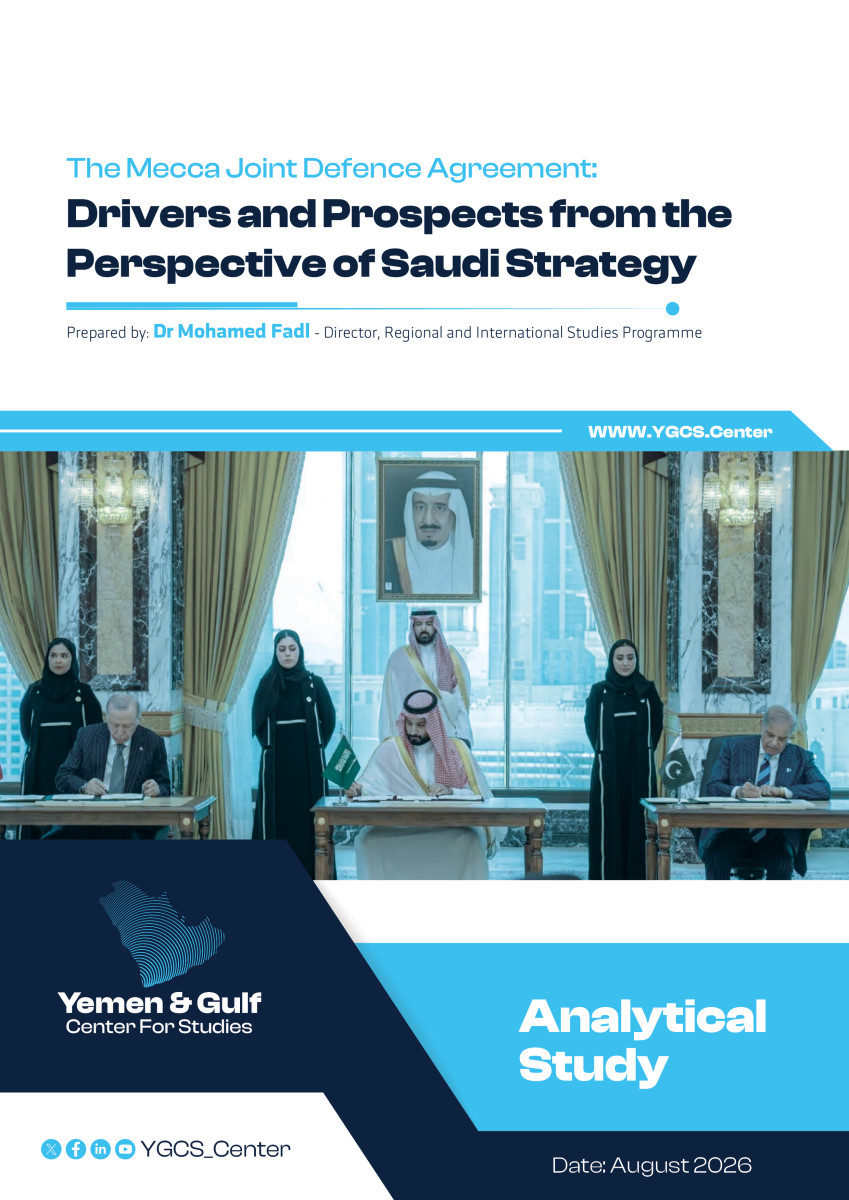
The rapidly evolving US-Iran war is confronting regional states with a new set of strategic realities, prompting them to rethink the configuration of their security alliances and how they respond to a rapidly changing regional environment. Against this backdrop, the Mecca Joint Defence Agreement, signed on 7 August 2026 by the Kingdom of Saudi Arabia, the Republic of Türkiye and the Islamic Republic of Pakistan, marks a significant milestone in the ongoing reconfiguration of regional security alliances.
This study examines the trilateral alliance from the perspective of Saudi strategy, focusing on the security and strategic considerations that prompted the Kingdom to establish this joint defence framework. It also assesses the alliance's potential implications for the regional security architecture amid the rapid transformations reshaping the region.
The analysis is structured in three main sections. The first sets out the theoretical and conceptual framework underpinning the study. The second examines the factors that drove Saudi Arabia to establish this joint defence framework. The third considers the agreement's future prospects, including the opportunities and challenges it may face.
First: Analytical Framework of the Study:
This study proceeds from the assumption that the international system is anarchic and non-hierarchical, with no overarching authority capable of enforcing international law upon states.
In such a system, uncertainty and mutual suspicion prevail, particularly because states cannot know one another's intentions with certainty.[1]
Under these conditions, states seek to increase their power to safeguard their security and stability. In a "self-help" system, their overriding objective is survival in an inherently dangerous world. States therefore think and act strategically and cautiously, seeking to strengthen their power and military capabilities. [2]
The uncertainty and apprehension inherent in the international system also drive states to pursue a balance-of-power policy. [3] The aim is to prevent the balance of power from shifting in favour of a particular state or group of states, thereby preventing any single actor from establishing dominance over the regional system. States pursue this objective through a range of strategies, foremost among them the formation of alliances. [4]
Crucially, however, states do not seek to balance power for its own sake; they seek to balance against perceived threats. Their behaviour is therefore shaped not simply by the relative power of another state, but by the extent to which that state is perceived as posing a threat to the prevailing balance of power.
Balancing is therefore a natural response to states' fear of potential threats. Stephen Walt identifies four key determinants that shape how states perceive the threats posed by others: [5]
- Aggregate power: the overall resources available to a state, including its population, economic strength and industrial capabilities.
- Geographic proximity: the closer a powerful state is geographically, the greater the threat it is likely to pose to neighbouring states, increasing their incentive to form alliances to balance against it.
- Offensive capabilities: the greater a state's offensive capabilities, measured in terms of the size and sophistication of its military forces and its ability to mobilise them rapidly, the greater the threat it is likely to pose to other states.
- Perceived aggressive intentions: the more State A perceives State B as harbouring aggressive intentions that it may seek to pursue in the future, the more likely State A is to enter into an alliance to constrain State B. This determinant plays a decisive role in shaping states' balance-of-threat policies.
A fifth determinant may be added to this framework: collective identity. This helps explain why states may perceive the capabilities of some states as threatening while expressing no comparable concern about similar capabilities possessed by others. The greater the degree of shared identity, the greater the scope for cooperation between states; conversely, cooperation is likely to diminish where their identities diverge. [6]
Second: Drivers of the Trilateral Alliance:
Building on this analytical framework, this section examines the underlying factors that prompted Saudi Arabia to establish the trilateral alliance. It focuses on three principal drivers: eroding trust in the United States, the growing Iranian threat, and the escalating Israeli threat.
- The United States as an Unreliable Ally:
Saudi Arabia's confidence in the United States' commitment to its security guarantees in the Arabian Gulf appears to have eroded considerably.
This erosion of trust is not a recent development. It can arguably be traced back to the US invasion of Iraq in 2004, which Saudi Arabia perceived as having effectively handed Iraq over to Iran. This marked the beginning of a broader Saudi perception that the United States was prepared to act unilaterally without sufficient regard for the interests of its allies. These concerns deepened under the Obama administration, particularly with the conclusion of the nuclear agreement with Iran without adequately addressing Saudi concerns. They were further reinforced by what Riyadh perceived as a weak US response to Iranian and Russian intervention in Syria. [7]
Further concerns arose as the United States pursued a strategy of military redeployment, reducing its presence in the Middle East while shifting its strategic focus towards the Indo-Pacific in an effort to constrain China's rise in the region. [8]
Against this backdrop, Saudi Arabia increasingly came to recognise that, despite US security assurances, it could not rely entirely on the United States to safeguard its security. As the analytical framework outlined above suggests, states can never be certain of one another's intentions, leaving interstate relations inherently marked by uncertainty and mistrust. Saudi Arabia therefore had to assume greater responsibility for its own security.
The Kingdom did precisely that when it intervened directly in the war in Yemen, launching strikes against the Iran-backed Houthi militias, which it regarded as posing an existential threat to its security. This represented a decisive turning point in Saudi-US relations. Riyadh was taken aback by what it regarded as insufficient US support for its military campaign in Yemen; instead, Washington exerted pressure on the Kingdom to bring the war to an end. [9]
This sense of disappointment persisted during Donald Trump's first term. The US position remained, in Saudi eyes, weak and insufficiently supportive of the Kingdom's military campaign, a perception reinforced by Trump's demand that Saudi Arabia pay more for US protection. [10]
The limited US response to the 2019 attacks on Saudi Aramco facilities further deepened these concerns. President Donald Trump stated: "There is no need to rush. This was an attack on Saudi Arabia, not on us."[11] The statement can be seen as having dealt a profound shock to Saudi-US relations.
The erosion of Saudi confidence continued under President Joe Biden, who had pledged during his election campaign to make Saudi Arabia a "pariah".[12] After taking office in 2021, his administration adopted several measures that ran counter to Saudi interests. Most notably, it removed the Houthis, whom Saudi Arabia was fighting in Yemen, from the US list of designated terrorist organisations,[13] and withdrew Patriot missile batteries that had been protecting the Kingdom against periodic Houthi ballistic missile attacks.[14] The Biden administration also temporarily suspended certain arms sales to Saudi Arabia. [15]
Perhaps the most consequential development in the erosion of Saudi confidence in the credibility of US security commitments came on 28 February 2026, when the United States, in coordination with Israel, launched a large-scale air campaign against several Iranian targets. Iran subsequently launched extensive drone and missile attacks against several Gulf states, exposing the limited degree of prior coordination between Washington and its Gulf allies, particularly as the United States had not informed them in advance of its intention to launch a major attack on Iran.
Moreover, US forces did not play an effective role in intercepting the missiles targeting the Gulf states. Instead, US military efforts were concentrated on protecting Israel and US bases, leaving the Gulf states to confront the Iranian attacks largely through their own capabilities. [16]
Taken together, these developments appear to have led Saudi Arabia to conclude that the United States could no longer be relied upon as its principal security guarantor. When the Kingdom faced direct threats that called for US security commitments to be put into effect, Washington did not provide the level of support Riyadh expected.
Saudi Arabia consequently turned towards a new security alliance with powerful regional states with which it shares a collective identity and a common perception of threat. The Mecca Joint Defence Agreement, signed on 7 August 2026 between Saudi Arabia, Türkiye and Pakistan, emerged from this strategic calculus.
The agreement explicitly stipulates that an armed attack against any one of the three states shall be considered an attack against them all, in contrast to US security commitments, which are not underpinned by a binding mutual defence treaty. [17]
- The Growing Iranian Threat:
Since the Iranian Revolution, Iran has made no secret of its desire to overthrow the ruling regime in Saudi Arabia. Iranian officials have also repeatedly threatened military action against the Kingdom.
For example, Ahmad Khatami, a member of Iran's Assembly of Experts, described Saudi Arabia as "a state of sedition" that "will be consumed by the flames of the sedition it has ignited". [18] Hashemi Rafsanjani, while serving as a member of parliament, similarly stated that "Iran must uproot the ruling Saudi family".[19] Such statements were not confined to rhetoric. Iran also moved early to encircle Saudi Arabia from the north and south.
Since the early 2000s, for example, Tehran has trained, equipped and armed the Houthi militias [20]
an involvement documented in several United Nations reports. [21] Following the Houthis' seizure of the Yemeni capital, Sana'a, former Iranian Intelligence Minister Heydar Moslehi stated that Sana'a had become the fourth Arab capital to come under Iranian influence. He added that the Iranian Revolution recognised no borders and extended to all Shia communities. [22]
Iranian influence was not confined to Saudi Arabia's southern flank. It also extended to the Kingdom's northern border through Iraq. Since the US invasion of Iraq in 2003, Iran has built and supported numerous armed Shia militias, providing them with financial and military assistance that has enabled them to develop into a significant military force with approximately 50,000 fighters and advanced weapons, including cruise missiles and drones. Since 2023, these militias have carried out dozens of missile and drone attacks against Saudi Arabia and other Gulf states. [23]
Nor has the Iranian threat to Saudi Arabia been confined to the use of regional proxies. It has also extended to direct attacks against Gulf states. Between 28 February and 6 March 2026, Iran launched approximately 380 missiles and 1,480 drones towards Gulf Cooperation Council (GCC) states.
Iran also sought to disrupt navigation through the Strait of Hormuz and targeted numerous oil tankers.[24]
At the same time, it encouraged the Houthi militias to attack vessels heading to Saudi Red Sea ports to load oil, declaring that no oil would be exported from the region for as long as the US naval blockade of Iran remained in place. [25]
In this way, Iran has sought to hold the security of the Gulf states hostage to strengthen its bargaining position vis-à-vis the United States.
Viewed through the analytical framework outlined earlier, Iran can therefore be said to possess all five of the key attributes identified as shaping states' perceptions of threat. It possesses substantial aggregate power and geographical proximity to Saudi Arabia, as well as extensive offensive missile capabilities capable of threatening the Kingdom's critical infrastructure.
Nor does Iran conceal its aggressive intentions. It has moved beyond declared intent to direct attacks against Saudi critical infrastructure. Finally, its identity differs from that of Saudi Arabia, with Iran seeking to mobilise its Shia identity to rally fighters under the banner of confronting the "Descendants of Muawiya". [26]
Against this backdrop, Saudi Arabia's decision to enter into an alliance with Pakistan, which has access to the Arabian Sea and the Indian Ocean and lies close to the Strait of Hormuz, and Türkiye, which shares an extensive land border with Iran, brings together the advantages of material power and a shared collective identity rooted in Sunni Islam. This combination strengthens cohesion among the alliance members and enhances the prospects for its effectiveness.
The alliance could therefore help constrain Iran's ability to disrupt the regional balance of power and reduce the prospect of its emergence as a hegemonic power capable of holding the region's energy security hostage to strengthen its bargaining position.
- The Growing Israeli Threat:
Since the outbreak of Israel's war in Gaza in 2023, Israel has committed numerous atrocities against the Palestinian people that have reached the level of genocide, without facing effective accountability for these actions. Instead, the United States has shielded Israel from international accountability. Against this backdrop, Saudi Arabia came to perceive the regional balance of power as increasingly skewed, particularly following Israel's execution of a series of complex operations inside Iran, its involvement in the assassination of Iran's Supreme Leader and most of the country's senior leadership, and its success in assassinating most of Hezbollah's senior leaders.
Taken together, these developments heightened Saudi perceptions of the growing Israeli threat and the possibility that Israel could emerge as a regional hegemon. [27]
This perception was further reinforced by Israel's strike on the Qatari capital, Doha, and its attempt to assassinate the Palestinian negotiating delegation. The absence of any meaningful US response, together with the failure of the US base in Qatar to intercept the Israeli aircraft, prompted Saudi Arabia to reassess the scale of the Israeli threat. [28]
The timing is particularly significant. Israel struck Qatar on 9 September 2025; on 17 September, approximately one week later, Saudi Arabia concluded its first mutual defence agreement with Pakistan. This sequence provides a clear indication that the agreement represented an initial response to the Israeli strike on Qatar and to Israel's declaration that it would strike any state it deemed a threat, at any time. [29]
Against this backdrop, Saudi Arabia's entry into an alliance with Pakistan, a nuclear-armed state, and Türkiye, with its highly trained and capable naval and ground forces as well as its advanced defence industry, [30] could help contain Israel, prevent it from disrupting the regional balance of power, and forestall its emergence as a hegemonic power capable of threatening other states in the region.
Third: Future Prospects and Challenges:
Despite the potential security benefits of mutual defence treaties, achieving a balance of power through alliance formation is far from straightforward. Translating an alliance into operational reality can be a slow process, requiring considerable time to coordinate efforts, operations and joint missions among the allies, as well as to establish a unified command capable of directing joint forces in the field. [31]
Against this backdrop, both Iran and Israel may seek to test the effectiveness of the agreement. In Iran's case, it can be expected to mobilise its proxies in Iraq and Yemen to carry out coordinated attacks against a range of high-value strategic targets inside Saudi Arabia, including energy facilities and desalination plants.
This prospect is consistent with a Saudi statement that the Kingdom had obtained intelligence indicating that the Houthi militias in Yemen and Popular Mobilisation Forces (PMF) militias in Iraq, under the supervision of Iran's Islamic Revolutionary Guard Corps (IRGC), were planning large-scale, coordinated attacks against sensitive targets inside the Kingdom. [32]
Iran is therefore likely to test the effectiveness of the trilateral alliance's response to such attacks and recalibrate its future policy accordingly. The stronger and more decisive the alliance's response to these probing attacks, the greater the pressure on Iran to revise its military posture and exercise greater caution in targeting Saudi facilities in the future.
This would not, however, necessarily deter Iran from risking attacks on Saudi critical infrastructure if the United States were to strike Iranian strategic facilities following the failure of the ongoing US-Iran negotiations.
Israel, by contrast, is likely to test the alliance differently. It may escalate its violations in the West Bank and Gaza, expand its settlement policy, disregard the two-state solution, and intensify military pressure on the new regime in Syria without launching a full-scale attack, thereby testing the extent to which the three states can mount a unified diplomatic response. Israel recognises that a new military venture is not currently in its interests as it seeks to concentrate its efforts on Iran.
Over the longer term, however, the trilateral alliance could have wider implications for the regional order. If it succeeds in coordinating its efforts and unifying its military and diplomatic responses, it could make a significant contribution to restoring the regional balance of power and potentially give rise to a broader regional order, particularly if major Arab states such as Egypt were to join the agreement.
Such a development could also reduce the region's reliance on the US presence as a means of guaranteeing regional security, thereby easing the tensions that this presence has generated since the Second Gulf War. This outcome is by no means assured, however. Its realisation will ultimately depend on the sincerity and seriousness with which the alliance members uphold their commitments.
Conclusion
This study concludes that the establishment of the trilateral alliance between Saudi Arabia, Türkiye and Pakistan under the Mecca Joint Defence Agreement marks a significant shift in Saudi security thinking: a move away from near-total reliance on the US security umbrella towards more autonomous defence arrangements based on diversified partnerships and the pursuit of a new regional balance of power.
The analysis shows that this shift was not driven by any single factor, but emerged from an accumulation of security and strategic considerations, most notably declining confidence in US security commitments, the growing Iranian threat, and mounting concerns that the regional balance of power could tilt in Israel's favour.
The study further demonstrates that the trilateral alliance is grounded in the logic of balance of threat. Through this alliance, Saudi Arabia seeks to bring together the complementary military and political capabilities of the three states, raising the cost of potential threats and strengthening its deterrent capacity.
The alliance's success, however, will depend on the ability of its members to overcome significant practical challenges, foremost among them establishing effective mechanisms for military coordination, aligning their political positions, and translating the agreement from written commitments into an effective security framework.
The Mecca Joint Defence Agreement could therefore mark the beginning of a new pattern of security arrangements in the Middle East. Whether it does so, however, will depend on the resilience of the alliance, its ability to withstand future challenges, and the capacity of its members to translate shared interests into sustained strategic cooperation.
[1] جون ميرشايمر، مأساة سياسة القوى العظمى، ترجمة: مصطفى قاسم، (السعودية: جامعة الملك سعود، ٢٠١٢م) ، ص ٣٨.
[2] John J. Mearsheimer," The False Promise of International Institutions," International Security 19, no.3(1994): 9-10.
[3] Mearsheimer," The False Promise," 12-13.
[4] Kenneth N. Waltz, "Structural Realism after the Cold War", International Security 25, no. 1 (2000): 38.
[5] Stephen M. Walt, The Origins of Alliances (New York: Cornell University Press, 1990), 22-26.
[6] محمد فضل، الهوية والسياسة الخارجية للقوى المتوسطة: السياسة الخارجية الأسترالية تجاه منطقة الإندو-باسيفيك منذ ٢٠٠٥،(أطروحة دكتوراه، معهد البحوث والدراسات العربية القاهرة، ٢٠٢٦)، ص ٦٤.
[7] Maria Fantappie and Vali Nasr, "A New Order in the Middle East? Iran and Saudi Arabia’s Rapprochement Could Transform the Region," Foreign Affairs, March 22, 2023, accessed August 7, 2026, https://www.foreignaffairs.com/middle-east/new-order-middle-east.
[8] محمد برهومة، "جدية الانسحاب الأمريكي من الشرق الأوسط وجولة الصراع في القدس وغزة،" صدى – مؤسسة كارنيغي للسلام الدولي، 2 يونيو 2021، تاريخ الاطلاع: 7 أغسطس 2026، https://carnegieendowment.org/sada/84666
[9] "كيري يطالب بوقف إطلاق النار بأسرع ما يمكن في اليمن،" DW، 16 أكتوبر 2016، تاريخ الاطلاع: 7 أغسطس 2026، https://www.dw.com/ar/كيري-يطالب-بوقف-إطلاق-النار-بأسرع-ما-يمكن-في-اليمن/a-36055258
[10] "ترامب: قلت لملك السعودية ادفعوا لنحميكم وتجاوب معي،" الجزيرة نت، 3 نوفمبر 2019، تاريخ الاطلاع: 7 أغسطس 2026، https://shorturl.at/5BUQJ
[11] Chris Megerian and Nabih Bulos, "Trump Says 'No Rush' to Respond to Attacks on Saudi Oil Facilities," Los Angeles Times, September 16, 2019, accessed August 7, 2026, https://www.latimes.com/politics/story/2019-09-16/trump-faces-difficult-options-on-iran.
[12] "زيارة جو بايدن للشرق الأوسط: لماذا غيّر الرئيس الأمريكي رأيه بشأن جعل السعودية «دولة منبوذة»،" بي بي سي عربي، 13 يوليو 2022، تاريخ الاطلاع: 7 أغسطس 2026، https://www.bbc.com/arabic/inthepress-62145341
[13] إلغاء تصنيف الحوثيين جماعة إرهابية،" بي بي سي عربي، 14 فبراير 2021، تاريخ الاطلاع: 7 أغسطس 2026، https://www.bbc.com/arabic/inthepress-56063259
[14] "أميركا تسحب بطاريات صواريخ من السعودية والرياض تؤكد قوة العلاقات،" الجزيرة نت، 11 سبتمبر 2021، تاريخ الاطلاع: 7 أغسطس 2026، https://shorturl.at/jnJzE
[15] "مصادر مطلعة لـCNN: إدارة بايدن أوقفت مبيعات الأسلحة إلى السعودية والإمارات مؤقتًا،" CNN العربية، 27 يناير 2021، تاريخ الاطلاع: 7 أغسطس 2026، https://arabic.cnn.com/middle-east/article/2021/01/28/biden-admin-pauses-arms-sales-saudi-arabia-and-uae-sources-say
[16] Samy Magdy, Michelle L. Price, and Aamer Madhani, “Gulf Allies Disappointed U.S. Didn't Notify About Iran Attacks and Ignored Their Warnings, Sources Say,” PBS NewsHour, March 6, 2026, accessed August 7, 2026, https://shorturl.at/OknAS
[17] "السعودية وتركيا وباكستان توقّع اتفاقية مكة للدفاع المشترك،" صحيفة الشرق الأوسط،٧/٨/٢٠٢٦ ، https://shorturl.at/JYwyd
[18] "رجل دين إيراني يقول السعودية مركز الفتنة،" رويترز، 6 أبريل 2012، تاريخ الاطلاع: 7 أغسطس 2026، https://www.reuters.com/article/oegtp-iran-saudi-mz7-idARACAE8350F320120406.
[19] عادل عنتر علي زعلوك، "العلاقات السعودية الإيرانية في القرن الحادي والعشرين: بين ميزان القوة وتوازن الهويات،" المجلة العلمية لكلية الدراسات الاقتصادية والعلوم السياسية، جامعة الإسكندرية، المجلد 7، العدد 13 (2022): ص 392.
[20] "تقرير أممي: إيران تسلح الحوثيين باليمن منذ 2009 على الأقل،" فرانس 24 عربي، 1 مايو 2015، تاريخ الاطلاع: 7 أغسطس 2026، https://www.france24.com/ar/20150501-تقرير-إيران-تسليح-الحوثيون-اليمن-2009-الأمم-المتحدة
[21] قرير للأمم المتحدة يكشف عن أدلة جديدة على تسليح إيران للحوثيين في اليمن،" فرانس 24 عربي، 31 يوليو 2018، تاريخ الاطلاع: 7 أغسطس 2026، https://www.france24.com/ar/20180731-تقرير-الأمم-المتحدة-أدلة-جديدة-دور-إيران-تسليح-دعم-الحوثيين-اليمن
[22] "وزير إيراني سابق: نسيطر على 4 عواصم عربية،" العربية نت، 2 أبريل 2015، تاريخ الاطلاع: 7 أغسطس 2026، https://www.alarabiya.net/iran/2015/04/02/وزير-إيراني-سابق-نسيطر-على-4-عواصم-عربية
[23] Michael Georgy, " Explainer: Who are Iraq's Iranian-backed armed groups", July 29, 2026, access accessed August 7, 2026, https://shorturl.at/DJNa7
[24] Samy Magdy and Michelle L. Price, “Gulf Allies Disappointed U.S. Didn’t Notify About Iran Attacks and Ignored Their Warnings, Sources Say,” Associated Press, March 10, 2026, accessed August 7, 2026, https://apnews.com/article/iran-us-trump-gulf-states-drones-defense-69d5bc227e468f06e20e5ad069330c7d.
[25] Enas Alashray, Tala Ramadan, Kanishka Singh, and Samia Nakhoul, “Iran Threatens to Block More Vital Seaways as Trump Orders Renewed Iran Blockade,” Reuters, July 15, 2026, accessed August 7, 2026, https://www.investing.com/news/commodities-news/iran-threatens-to-block-more-vital-seaways-as-trump-orders-renewed-iran-blockade-4792147.
[26] إبراهيم الدراجي، "أحفاد معاوية عن استحلال دماء السنة في إيران"، الجزيرة نت، 23 يوليو 2017، تاريخ الاطلاع: 7 أغسطس 2026، https://shorturl.at/fRawt
[27] Ismail Numan Telci, “The Emergence of a Regional Security Framework: Türkiye, Pakistan, Saudi Arabia and Egypt,” Al Jazeera Centre for Studies, May 14, 2026, accessed August 7, 2026, https://studies.aljazeera.net/en/analyses/emergence-regional-security-framework-t%C3%BCrkiye-pakistan-saudi-arabia-and-egypt.
[28] Anchal Vohra, "The Middle East Has a New Saudi-Led Axis With Qatar, Turkey, Pakistan, and Egypt—but Not the UAE," Foreign Policy, July 1, 2026, accessed August 7, 2026, https://foreignpolicy.com/2026/07/01/saudi-qatar-pakistan-turkey-egypt-uae-axis-alliance-iran-middle-east/.
[29] "رئيس الأركان الإسرائيلي بعد هجوم قطر: سننفذ مهامنا فى أى مكان وبأى مدى،" اليوم السابع، 10 سبتمبر 2025، تاريخ الاطلاع: 7 أغسطس 2026https://shorturl.at/jP1xX
[30] Brady Knox, “How Turkey Came to Position Itself as a Dominant Power in the Middle East and Beyond,” Washington Examiner, June 14, 2026, accessed August 7, 2026, https://www.washingtonexaminer.com/news/world/4607678/turkey-dominant-power-middle-east-beyond/
[31] جون ميرشامير، مصدر سابق، ص١٩٨-١٩٩.
[32] تيمور أزهري، "مسؤول: السعودية تتوقع هجمات منسقة من حلفاء لإيران"، رويترز ، 6 أغسطس 2026، تاريخ الاطلاع: 7 أغسطس 2026، https://www.reuters.com/ar/world/2XKHZIGODNNDRGVPVEN4VNVMDE-2026-08-06