
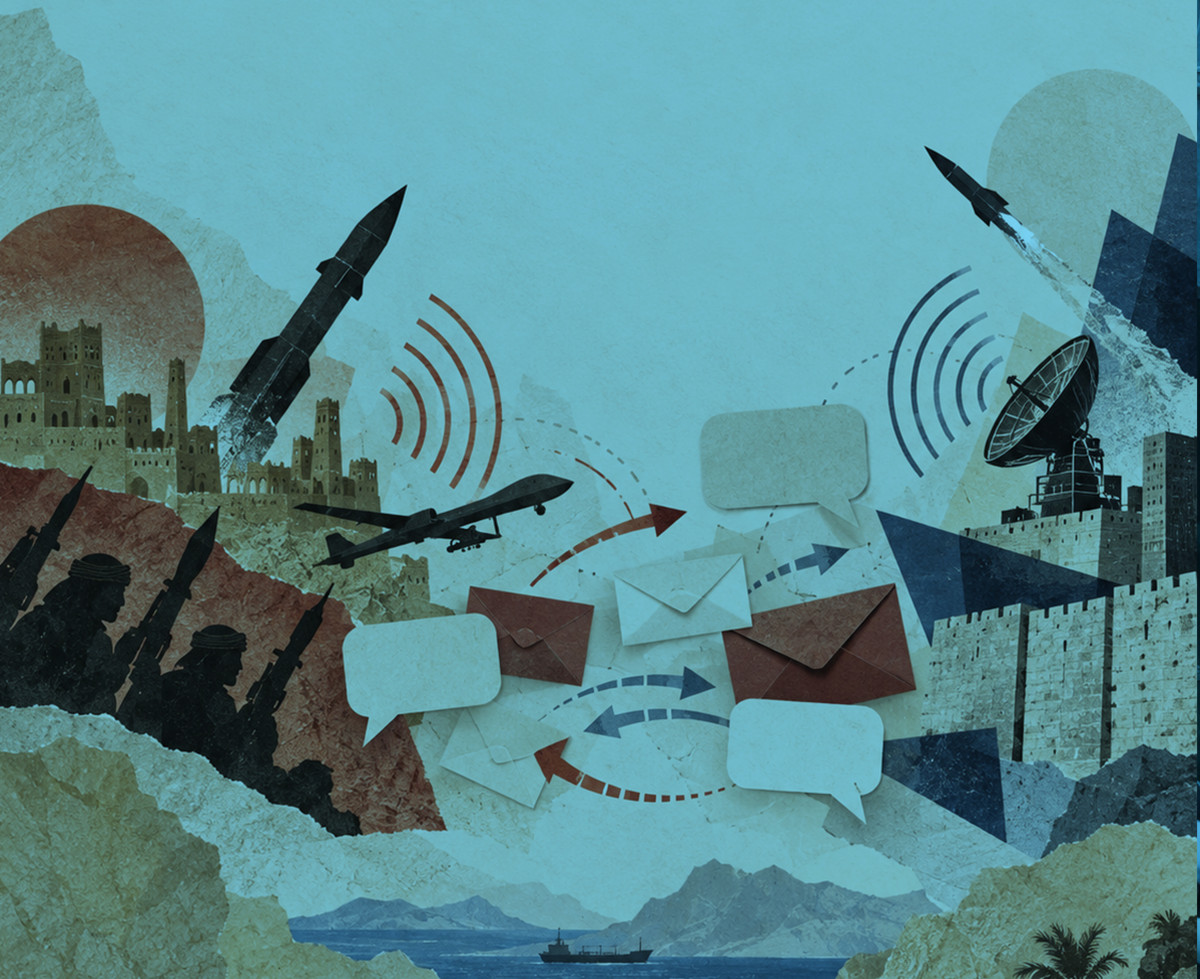
The Houthi-Israel War of Messages: A Comparative Analysis of Rhetorical Functions and Diverging Priorities since the Resumption of the Yemeni Conflict in July 2026
Throughout July and August 2026, a marked disparity emerged between Houthi and Israeli discourse towards one another. While Houthi rhetoric displayed considerable intensity at both the official and media levels, official Israeli discourse accorded Yemen a lower priority than other regional issues and fronts, amid Israel’s engagement across multiple theatres, particularly in Gaza, Lebanon and Syria. Neither statements by Israeli government officials nor official media coverage revealed significant interest in, or extensive discussion of, developments in Yemen or Israel’s position towards the Houthi movement.
By contrast, statements by Houthi officials and coverage by affiliated media outlets placed considerable emphasis on attacking Israel and calling for popular mobilisation against it in Yemen and across the wider Arab and Islamic worlds, presenting Israel as the principal enemy. This report analytically assesses how official and media discourse on both the Houthi and Israeli sides has engaged with developments in Yemen and the messages exchanged between them. It also examines the rationales and rhetorical frameworks through which each side has framed its position towards the other.
First: Israel in Houthi Discourse: The Central Enemy
- Israel as the Central Enemy: The Institutional and Functional Foundations of the Discourse
Houthi discourse has invoked Israel extensively, both by portraying it as a hostile entity and by condemning what it describes as Israel’s hostile actions in the Palestinian territories and across the wider region, particularly in Lebanon and Syria. This can be understood through the literature on discursive legitimation, in which constructing an "enemy" builds political and ideological legitimacy for the group. The Houthis thus present themselves as an active party to a confrontation framed as existential and extending beyond Yemen’s national borders ([1]).
This discourse emanated primarily from the group’s leader, Abdul-Malik al-Houthi, and members of its Political Bureau. It therefore assumed a mobilising and exhortatory character, marked by an impassioned tone that drew on religious vocabulary such as "jihad", "martyrdom", and al-wala’ wa al-bara’ ("loyalty and disavowal"), alongside the invocation of the Palestinian cause. From a critical discourse analysis perspective, this rhetoric performs two interrelated functions: first, legitimising military action; and second, mobilising the public and broadening the group’s base of sympathy. It does so by emphasising the "legitimacy" of Houthi military operations, presenting them as intended solely to defend what the discourse describes as "oppressed peoples", whether Yemeni or Palestinian.
This framing helps alleviate domestic public pressure on the group while also generating greater sympathy among Arab publics in any confrontation it undertakes. Accordingly, whether its confrontation with Israel is direct or indirect, the discourse retains the same underlying structure. During direct confrontations, however, it becomes more strident and threatening, identifying with greater specificity the military targets the group intends to strike.
2. Affiliation with the “Axis of Resistance”: Adopting Its Rhetoric and Invoking the Legacy of the 2006 War
As an extension of what is known as Iran’s "Axis of Resistance", the Houthi movement has adopted the vocabulary and terminology of its discourse. References to resisting Israel and confronting US influence in the Middle East have recurred throughout Houthi rhetoric, alongside repeated affirmations of support for all members of the axis, foremost among them Hezbollah in Lebanon.
This was particularly evident in a statement the group issued on 15 August to commemorate the 2006 Lebanon War. ([2]) The statement employed highly charged, glorifying language to portray the efforts of the "Axis of Resistance" in confronting the injustices suffered by peoples. It described the "resistance" as a "model to be emulated in the Arab chips and Islamic worlds", credited it with delivering a "historic defeat to Israel", and stated that it had established a "strategic balance of deterrence and new rules of engagement".
The statement further claimed that the "resistance" had contributed to "thwarting US-Israeli plans in the region", including what it termed the "New Middle East", as well as "efforts to dominate the region" and what it called the "Greater Israel Project". The discourse also portrayed the actions of the resistance forces as "sacrifices" made in confronting Israel and its expansionist projects.
3. Invoking the Palestinian Cause: Alignment between the Movement Leadership and the Sana’a Government
The Palestinian cause has likewise occupied a prominent place in Houthi discourse, which has addressed it from multiple perspectives. Particularly striking is the close alignment between the discourse of the group’s de facto leadership and that of its governmental apparatus. In his address on 30 July, ([3]) which represents the highest level of the group’s ideological movement discourse, Abdul-Malik al-Houthi advanced the same arguments subsequently articulated by Abdulwahid Abu Ras, Deputy Minister of Foreign Affairs and Expatriates in the unrecognised Sana’a government, in his remarks on 15 August. ([4]) Abu Ras spoke as a representative of the executive apparatus that formally speaks for the state.
Despite the speakers’ differing institutional positions, with one representing the movement’s religious leadership and the other its governmental executive, the substantive and stylistic convergence between their rhetoric reflects the extent to which the movement leadership’s ideological line has permeated the state institutions under Houthi control. The governmental apparatus thus functions as a discursive extension of the group’s de facto leadership rather than as an independent voice.
The two discourses converged in their invocation of the Palestinian cause in two principal ways. First, the cause was used to condemn Israeli practices and military operations and to justify both the emergence of the "Axis of Resistance" and its role in confronting those actions, protecting Palestinians, and defending their cause. Second, the Palestinian cause was endowed with an Islamic and indeed global dimension. The discourse claimed that it sought to "support oppressed peoples throughout the world", alleged that "the enemies of Islam are targeting humanity as a whole", and maintained that "the threat posed by the Zionist movement extends to human society in its entirety".
In the same context, Houthi discourse, as reflected in Abdul-Malik al-Houthi’s address on 16 July,([5]) sought to draw parallels between the Yemeni and Palestinian peoples by portraying both as suffering from blockades and military attacks and as engaged in resisting them. This linkage situates the Yemeni experience within the broader framework of a narrative of victimhood and resistance, while connecting Yemen’s internal conflict to the Israeli-Palestinian conflict.
4. The Domestic Dimension: Invoking Tribal Honour and Popular Self-Sacrifice
Alongside these regional and Palestinian dimensions, Houthi discourse devotes comparable attention to the psychology of ordinary Yemenis, invoking a spirit of self-sacrifice and tribal honour. It addresses the Yemeni people and tribes as communities that will neither tolerate aggression nor remain silent in the face of it. Abdul-Malik al-Houthi invoked this sentiment in his mid-July address when he questioned whether the Yemeni people would accept submission to any outside power: "Would our dear people, our free tribes, which have remained free throughout our history, accept being enslaved and subjugated?"
The same rhetorical pattern recurred during the mass rally held in response to the Houthi leader’s call following his address. Held on 18 August under the banner "Friday of Warning and Mobilisation", the rally coincided with an exchange of strikes with Saudi Arabia. Its statement invoked the courage and honour of Yemen’s various tribes, declaring: "The people of faith, wisdom, jihad, pride, and dignity, drawing on the accumulated strength of their faith and history, and with their army and tribes, their old and young, their men and women, their land and sky, their stones and trees, affirm that their choice is freedom, dignity, and independence, and that they will neither submit nor bow to anyone but God alone, who has no partner.([6])
5. The Religious Dimension: Domestic Polarisation between “Loyalty” and “Disavowal”
At the religious level, the Houthi movement’s radical religious and ideological frame of reference has meant that its use of such religious vocabulary as "jihad", "martyrdom", and al-wala’ wa al-bara’ ("loyalty and disavowal") has been accompanied by the classification of states and actors that oppose the group or its practices as either hostile to Islam or aligned with the "enemies of Islam and Muslims". This rhetorical pattern serves a distinctly domestic polarising function by dividing actors into two opposing camps framed as "loyalty" and "disavowal". In doing so, it reinforces popular loyalty to the group and mobilises support against its adversaries in both Yemeni and regional arenas. ([7])
6. External Outreach: Mobilising Regional and International Support
Alongside this domestic polarising function, Houthi discourse also pursues a parallel, horizontally oriented objective: expanding support for the group beyond Yemen. It does so by portraying the confrontation with Israel and the Zionist movement as a cause that transcends national borders and concerns the Arab and Islamic worlds. This framing is reflected in assertions such as the claim that "the Zionist movement and its followers are targeting our Islamic nation".
The success of this Houthi strategy, both domestically and externally, can be inferred from the demonstrations periodically held in response to calls by the group’s leader, whether in support of the group’s activities and military operations or in solidarity with and support for the Palestinian cause. The function of this discourse therefore extends beyond legitimising confrontation with Israel. It also presents the Houthi movement as part of a broader struggle that transcends the Yemeni arena, enabling it to invoke the Palestinian cause and associated religious vocabulary to mobilise support and reinforce its political and ideological legitimacy at both the regional and international levels.
Second: Yemen in Israeli Discourse: Limited to Monitoring Developments
- Declining Official Attention: Geographic Proximity and Competing Fronts
Military operations between Israel and the Houthi movement resumed on several occasions over the course of the year. The group’s ban on Israeli shipping in the Red Sea from June 2026 also had adverse consequences for Israel. This followed the Houthis’ blockade of Israel’s Port of Eilat and their attacks on Israel-linked vessels during the Gaza war.([8]) Yet this sustained military escalation generated no comparable intensity in Israeli discourse, whether at the official or media level, during the two months under review.
Israel’s current policy agenda appears fragmented across multiple competing priorities. This is reflected in the limited attention that Israeli officials devoted to developments in Yemen, particularly compared with other fronts that attracted considerably greater official attention over the same period.
On the Lebanese front, July and August witnessed an intensification of Israeli military operations in Lebanon, including repeated strikes on the country’s south. The most severe occurred on 15 August and resulted in the highest civilian death toll recorded since the June ceasefire with Hezbollah.([9])
The disparity in Israeli attention to the Yemeni and Lebanese fronts can be explained partly by direct geographic proximity. Israel is more readily mobilised by Hezbollah’s actions because the group operates across a shared border, unlike the Houthis. It has justified its military operations in Lebanon as necessary to protect central and northern Israel from the potential missile threat posed by Hezbollah. This reflects a strategy pursued by Israel since Operation "Al-Aqsa Flood", centred on creating buffer zones to prevent a recurrence of attacks targeting the Israeli home front.
The same logic helps explain Israel’s attention to Syria, which also shares a direct border with Israel. In August, Israel launched a military strike on the Abu al-Duhur airbase, claiming that the prospective deployment of Turkish forces there would breach an existing agreement. The attack thus acquired a third dimension beyond direct geographic proximity, encompassing regional balance-of-power considerations involving other actors, notably Türkiye.
Israeli attention was also directed more heavily towards developments in the US war against Iran, amid ongoing negotiations between Washington and Tehran aimed at reaching an agreement to end the conflict. The situation in the Gaza Strip constituted another major priority, particularly amid negotiations over the disarmament of Hamas and a settlement concerning the territory’s future. These external issues coincided with a parallel Israeli preoccupation with domestic developments, including legislative crises associated with the Knesset’s entry into the election period on 17 July, disruption at Ben Gurion Airport, and the mutiny of around 100 soldiers from the Givati Brigade’s Tzabar Battalion, among other crises.
- Media Discourse: Mutual Deterrence and Dual Characterisation
Against this backdrop of a temporary relative decline in official attention, Israeli engagement with Yemen occurred primarily through media coverage. This discourse followed military developments in Yemen from the outbreak of hostilities on 13 July. Still, it largely confined itself to reporting and tracking events without presenting Israel as a direct party to the conflict. The principal exceptions were several analytical reports that anticipated the possibility of renewed confrontation between Israel and the Houthi movement and examined each side’s concerns about a potential attack by the other.
The emergence of these two strands of reporting at the same time points to a dynamic of mutual deterrence constructed through the media more than formally articulated at the official level. A report in the Hebrew-language newspaper Maariv highlighted what it described as genuine Houthi fears of being targeted by Israel, using language that conveyed the scale of those concerns. It portrayed the Houthi movement as experiencing considerable anxiety, reaching the point of "panic", over the prospect of an Israeli attack and as viewing Israeli threats as both credible and serious.([10]) Conversely, a report in The Times of Israel, citing Haaretz, conveyed parallel Israeli concerns expressed by the head of the Israel Security Agency, Shin Bet, about the possibility of a 7 October-style attack from Yemen beginning in the southern coastal city of Eilat.([11])
The Israeli media’s simultaneous construction of narratives of “Houthi fear” and “Israeli fear” serves two complementary purposes. On the one hand, it preserves the image of Israeli deterrence by suggesting that the opposing side has more to fear. On the other, warnings from the Israel Security Agency provide a rationale for future security preparations or shifts in posture towards the Yemeni front without requiring an official declaration of direct escalation.
In its coverage of the Houthi movement, Israeli media discourse also distinguished between the group and what it presented as Yemen’s internationally recognised government. The group was variously described as "rebels", the "Ansar Allah movement", or simply "the Houthis", as in the Hebrew-language edition of Maariv. This distinction extends beyond ostensibly neutral news reporting. It implicitly preserves the legitimacy of the official Yemeni state as the internationally recognised party, while framing the Houthis as an illegitimate actor or an anomalous presence within the state’s political structure. This framing serves the Israeli position, and the broader international position, of refusing to recognise the group as a de facto authority.
In its coverage of the Houthi movement, Israeli media discourse also distinguished between the group and Yemen’s internationally recognised government. The group was variously described as "rebels", the "Ansar Allah movement", or simply "the Houthis", as in the Hebrew-language edition of Maariv. This distinction extends beyond ostensibly neutral news reporting. It implicitly preserves the legitimacy of the official Yemeni state as the internationally recognised party, while portraying the Houthis as an illegitimate actor with no established place in the state’s political structure. This framing serves the Israeli position, and the broader international position, of refusing to recognise the group as a de facto authority.
From a discourse-analysis perspective, the most revealing contrast is between this relatively "professional" media terminology and the official Israeli rhetoric employed by Prime Minister Benjamin Netanyahu, who has framed the group in terms of "terrorism" and referred to its members as "Houthi terrorists".
This linguistic divergence between media and official discourse is not merely stylistic; it reflects a difference in function. Media discourse maintains a degree of descriptive distance closer to an ostensibly neutral journalistic register, employing terms such as "rebels" and "Ansar Allah". Official discourse, by contrast, deploys the language of "terrorism" within a framework of political and legal legitimation. This enables any future military or security measures against the group to be presented as part of the "war on terror", rather than merely as actions within a limited regional conflict.
Official discourse thus places the Houthis within a category of enemies whose targeting can be legitimised on political and security grounds. Media discourse, by contrast, retains greater flexibility in treating the issue as a regional development warranting continued monitoring rather than direct confrontation.
Analysis of Israeli discourse towards Yemen therefore reveals a two-tiered pattern: official discourse is limited in volume but sharply characterises the group when it does emerge, whereas media discourse is more widely disseminated but more cautious in categorising the actors involved.
Conclusion
This analysis reveals a fundamental disparity between the two discourses. Houthi discourse, emanating from a non-state actor, has employed sustained rhetorical escalation against Israel to secure legitimacy, mobilise support, foster religious polarisation, and broaden regional backing for the group. Israeli discourse, by contrast, has remained restrained, largely confining itself to monitoring developments in Yemen.
This divergence reflects a structural asymmetry between an actor that must escalate rhetorically to command attention and establish credibility, and one that does not yet need to do so to be taken seriously. Whether this disparity persists will depend on the trajectory of military escalation between the two sides in the period ahead.
[1] Abo Alasrar, Fatima. "From Yemen to Palestine: The Strategic Depth of the Houthi-Iranian Alliance." Middle East Institute, February 16, 2024. https://mei.edu/publication/yemen-palestine-strategic-depth-houthi-iranian-alliance/.
[2] وكالة أنباء أهل البيت (ع) الدولية (أبنا). "أنصار الله يشيدون بانتصار حزب الله على إسرائيل عام 2006 باعتباره نموذجًا للعالم العربي والإسلامي." 15 أغسطس 2026. https://2u.pw/fRifrN.
[3] وكالة أنباء أهل البيت (ع) الدولية (أبنا). "السيد عبدالملك الحوثي: الهدف من الهجمات على محور المقاومة هو إزالة العوائق أمام مشروع إسرائيل الكبرى." 30 يوليو 2026. https://2u.pw/dEB2vS.
[4] وكالة أنباء أهل البيت (ع) الدولية (أبنا). "نائب وزير الخارجية: النظام السعودي منهمك في صناعة الأزمات في عموم دول المنطقة." 15 أغسطس 2026. https://2u.pw/SZ4dRO.
[5] وكالة أنباء أهل البيت (ع) الدولية (أبنا). "السيد الحوثي يؤكد رفضه لاستمرار الحصار وأن كل المنشآت النفطية والحيوية السعودية هي هدف لصواريخ اليمن." 16 يوليو 2026. https://ar.abna24.com/news/1841124/السيد-الحوثي-يؤكد-رفضه-لاستمرار-الحصار-وأن-كل-المنشآت-النفطية.
[6] وكالة أنباء أهل البيت (ع) الدولية (أبنا). ""جمعة التحذير والنفير".. جماهير مليونية تنزل إلى الشارع تأكيدًا على الجاهزية للرد على العدوان." 18 يوليو 2026. https://2u.pw/6Gwo2j.
[7] Rushdi, Nasr. "Al-Aqsa Flood and the Battle of the Promised Conquest: How the Houthis Mobilize Popular Support." Sana'a Center, April 9, 2024. https://sanaacenter.org/the-yemen-review/jan-mar-2024/22294.
[8] Long War Journal. "Houthis Attack Israel and Announce Ban on Israeli Vessels in the Red Sea." June 9, 2026. https://www.longwarjournal.org/archives/2026/06/houthis-attack-israel-and-announce-ban-on-israeli-vessels-in-the-red-sea.php.
[9] Ahram Online. "Lebanon State Media Says One Dead, 11 Wounded in Israeli Strike on South." August 5, 2026. https://english.ahram.org.eg/NewsContent/2/8/574118/World/Region/Lebanon-state-media-says-one-dead%2C--wounded-in-Isr.aspx.
[10] ليئون، إيلي. "الحرب تدخل مرحلة جديدة: الحوثيون يستعدون لفتح جبهة برية." معاريف، 20 أغسطس 2026. https://www.maariv.co.il/news/world/article-1357799.
[11] Levaton, Stav. "Alarm over Potential Eilat Attack Met with Skepticism, though Not toward Houthi Threat." The Times of Israel, July 8, 2026. https://www.timesofisrael.com/alarm-over-potential-eilat-attack-met-with-skepticism-though-not-toward-houthi-threat/.