

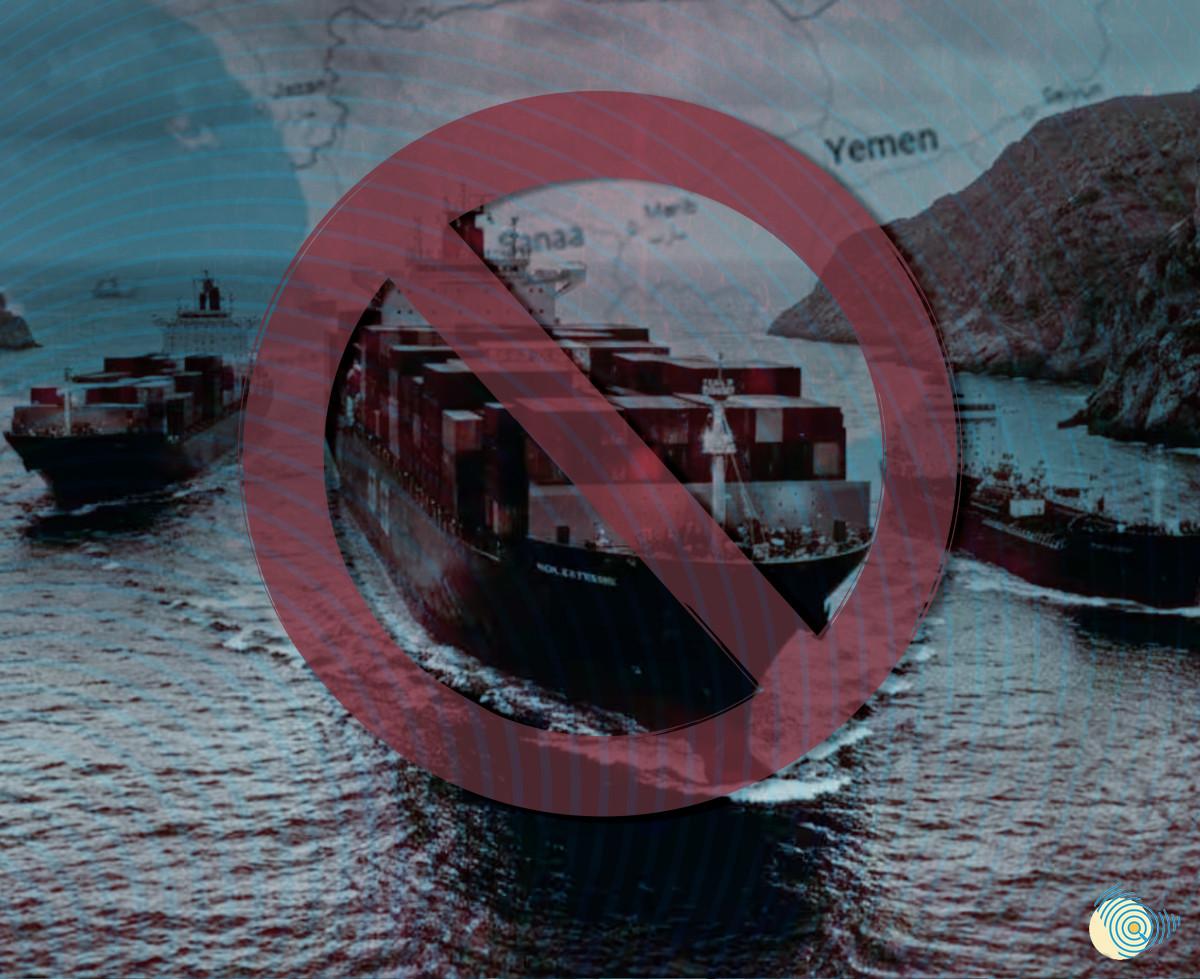
On 20 July 2026, the Houthi movement announced what it described as the imposition of a "maritime blockade" against the Kingdom of Saudi Arabia, threatening to target vessels bound for Saudi ports or associated with Saudi exports transiting the Red Sea and the Bab el-Mandeb Strait.
The announcement extended beyond political signalling. It was followed by an attempt to enforce the declared blockade operationally through an attack on the Saudi oil tanker Encelia, accompanied by the movement's subsequent claim that it had also targeted another tanker.
This escalation comes against the backdrop of an increasingly volatile regional environment marked by multiple theatres of confrontation and strategic competition between Iran and its regional and international adversaries. It raises important questions about the extent to which the Houthi escalation reflects the broader strategic calculations of the Islamic Revolutionary Guard Corps (IRGC) and its network of regional allies, as well as the movement's use of maritime coercion to broaden the scope of pressure and raise its regional and international costs.
The Kingdom responded through a multi-layered strategy that combined firmness with calibrated restraint. It rejected the purported blockade as lacking any legal legitimacy and framed the threat as an infringement of the freedom of navigation and international trade. At the same time, it strengthened protective measures for commercial shipping, ensured the uninterrupted flow of maritime traffic and exports, and reserved the right to respond to the sources of the threat.
This approach reflects a strategy of "graduated deterrence-based containment", aimed at preventing the Houthi threat from developing into either an effective maritime blockade or a sustained source of commercial leverage, while avoiding an immediate escalation into a large-scale military confrontation.
This assessment concludes that a pattern of limited reciprocal escalation is likely to persist. In contrast, the risk of broader escalation will remain should the attacks become linked to wider regional calculations or inflict significant damage on commercial shipping, ports, or oil infrastructure.
Accordingly, the challenge extends beyond Saudi Arabia's national security to encompass the security of international maritime navigation and global energy supplies. The central strategic imperative is therefore to prevent the Red Sea from becoming an arena for the further expansion of the conflict, while keeping channels for de-escalation open and maintaining a credible capacity to impose greater costs should hostile actions exceed the threshold of limited coercive pressure.
On 20 July 2026, the Houthi movement announced what it described as a "maritime blockade" against the Kingdom of Saudi Arabia, justifying the measure by accusing Riyadh of continuing what it characterises as a blockade of areas under the group's control in Yemen.
According to the group's statement, the declared blockade targeted vessels associated with Saudi trade and exports, as well as ships bound for Saudi ports via the Red Sea and the Bab el-Mandeb Strait. [1]
This announcement marks a significant shift from issuing broad threats against maritime navigation to explicitly designating the interests of a specific state as direct targets. It reflects the group's attempt to exploit both its strategic geographic position and its military capabilities to impose political and economic costs on the Kingdom.
From both legal and military standpoints, the Houthi movement lacks the requisite capacity to impose a "maritime blockade" in the conventional sense of the term, namely, one enforced by states in the context of a recognised armed conflict. Nevertheless, this does not preclude its ability to cause significant disruption to maritime traffic.
Its arsenal of ballistic and cruise missiles, unmanned aerial systems, uncrewed maritime platforms, and its demonstrated track record of threatening commercial shipping gives the group the capacity to significantly increase the security risks facing maritime traffic, even though it cannot establish sea control or completely close maritime routes. [2]
The most significant effect of this type of threat may, in fact, be indirect, by influencing the decisions of shipping companies and insurers and increasing the cost of using ports and maritime routes associated with Saudi trade.
The threat entered the operational domain on 22 July 2026, when the group announced that it had targeted two Saudi oil tankers, Encelia and Layla.
The Kingdom confirmed that the tanker Encelia had been struck, resulting in a fire in its bow, while affirming that all crew members were safe and that the situation had been brought under control. By contrast, no comparable independent confirmation was available regarding the reported strike on the second tanker. [3]
The escalation therefore moved beyond declarations and threats to an operational attempt to test the group's ability to strike maritime targets directly linked to the Saudi economy, while assessing the nature of the Kingdom's response and the reactions of shipping companies and insurers.
This development forms part of a broader trend in which the Red Sea is increasingly being used as a theatre of regional coercion, amid Iran's continued reliance on a network of affiliated armed groups and partners to project power indirectly, broaden the scope of confrontation, and increase the costs imposed on its adversaries.
From this perspective, the Houthi escalation should not be viewed as an isolated incident or merely as a bilateral dispute between the movement and the Kingdom. Rather, it should be understood as part of a broader regional pattern in which local and regional calculations intersect, with armed groups employed to open additional fronts of pressure against the vital interests of states and the global economy.
This dimension assumes even greater significance given that the Houthi movement represents one of the principal instruments of Iran's maritime coercive strategy. Its strategic position along one of the world's most important maritime corridors, coupled with its ability to threaten commercial shipping from Yemen's western coast, gives it a pivotal role within Iran's wider network of regional partners.
Moreover, the decision to direct the threat explicitly against Saudi trade and exports reflects a qualitative shift in the escalation. The objective is no longer confined to exerting pressure related to the war in Yemen or the broader regional confrontation; it now extends to targeting the economic and security interests of one of the region's leading powers.
Nor does the group need to impose a full maritime blockade to achieve its objective. It need only create a persistent threat environment that disrupts maritime traffic, drives up insurance costs, and compels shipping companies to reassess the risks associated with using Saudi ports and maritime routes.
Accordingly, the declaration of a "maritime blockade" represents an attempt to test three interrelated dimensions simultaneously: the group's ability to translate its threats into operational pressure; the Kingdom's willingness to bear the costs of protecting its maritime and economic interests; and the capacity of the regional and international community to prevent threats posed by an armed group from establishing a new precedent that undermines the security of maritime navigation and global energy supplies.
The implications of this escalation therefore extend well beyond Saudi Arabia's immediate security, encompassing the security of the Red Sea, the stability of international trade and energy routes, and the principle of freedom of navigation.
Figure 1 illustrates the distribution of territorial control and influence in Yemen as of July 2026, highlighting the Houthi movement's control over extensive stretches of the western Red Sea coastline. This provides the geographical context for understanding the maritime threats underpinning the declaration of the maritime blockade, while also underscoring the strategic importance of the group's geographic position in regional calculations concerning Red Sea security.

II. Dimensions of the Threats Facing the Kingdom
The Houthi movement's declaration of a "maritime blockade" against the Kingdom, followed by its targeting of Saudi oil tankers, represents an escalation that extends well beyond the immediate military dimension. It reflects an attempt to use maritime coercion to exert simultaneous pressure on the Kingdom's energy security, national economy, and regional standing, while broadening the threat to encompass the security of international maritime navigation and trade.
This escalation also forms part of a broader regional trend characterised by the growing use of non-state actors to pressure states and threaten critical maritime corridors, thereby increasing the risk that the Red Sea will become a sustained arena for conflict and geopolitical coercion. Against this backdrop, the principal dimensions of the threat can be analysed across four interrelated levels:
- Threat to Saudi Arabia's Energy Exports
By targeting vessels associated with Saudi interests, the Houthi movement seeks to increase the security risks surrounding maritime traffic bound for Saudi ports on the Red Sea, foremost among them King Fahad Industrial Port in Yanbu, which serves as the Kingdom's principal export terminal for crude oil and refined petroleum products shipped via the Red Sea.
In 2024, the port handled approximately 114 million tonnes of Saudi seaborne exports, accounting for 51.1% of the total volume exported through the Kingdom's ports. [4]
Nor does disrupting Saudi Arabia's energy exports require imposing a full maritime blockade or controlling maritime corridors. Sustained threats and limited attacks alone may be sufficient to increase the risks facing tankers and shipping companies, complicate voyage planning and insurance arrangements, and increase the likelihood that cargoes will be delayed or rerouted.
The potential repercussions also extend to the Kingdom's other commercial and industrial ports on the Red Sea, potentially disrupting the smooth flow of exports and imports, even if maritime traffic remains officially open.
- Increasing the Economic Cost of Maritime Transport
One of the most significant indirect consequences of the Houthi threat has been the sharp increase in shipping and insurance costs. Heightened security risks in the Red Sea have driven additional war-risk insurance premiums from around 0.3% of a vessel's value before the escalation to more than 1% thereafter, reaching approximately 3% of a vessel's value on some voyages to the southern Red Sea. These increases have been accompanied by higher security and operating costs. [5]
These developments illustrate the nature of the challenge facing the Kingdom. Even when the group is unable to strike vessels or disrupt port operations directly, it can still impose high economic costs by increasing risk levels and reshaping the commercial calculations of shipping companies and insurers.
The contest, therefore, is not simply about the ability to target vessels. Rather, it centres on the capacity of a sustained threat to influence the economic behaviour of commercial actors.
- Undermining the Kingdom's Reliability in Global Energy Markets
The security of oil flows through the Red Sea is a key pillar of the Kingdom's strategic position in global energy markets, particularly given the growing importance of King Fahad Industrial Port in Yanbu as a principal export terminal for Saudi crude oil.
According to Kpler data reported by Reuters, crude oil exports through the port rose to approximately 4 million barrels per day during the week beginning 16 March 2026, compared with an average of 770,000 barrels per day in January and February. Exports were projected to increase further to around 5 million barrels per day by the end of the month. [6]
These figures underscore the strategic importance of the Red Sea route within Saudi Arabia's energy export architecture. They also demonstrate that any sustained threat to navigation in the Red Sea could have consequences extending well beyond the disruption of individual shipments, affecting market confidence in the reliability of the Kingdom's export routes and its ability to ensure uninterrupted energy supplies.
Accordingly, the maritime threat should be understood as part of a broader global energy security equation, rather than merely a Saudi national security concern.
- Expanding the Houthis’ Regional Standing and Consolidating the “Maritime Proxy” Model
From a strategic perspective, the declaration of the maritime blockade seeks to reposition the Houthi movement from an armed actor operating within the Yemeni conflict to one capable of influencing international trade and global energy flows.
The more successfully the movement is able to threaten commercial shipping and increase the costs of maritime transport, the greater its ability to portray itself as an actor possessing influence that extends beyond the geographic limits of its territorial control.
This dimension assumes added significance within the broader regional context, in which Iran and its network of affiliated forces and armed groups rely on indirect forms of coercion to broaden the scope of confrontation and impose mounting costs on their adversaries.
Against this backdrop, the continued Houthi threat to maritime navigation could further strengthen the movement's position within the regional maritime security landscape, even though it lacks the capacity to impose a legally recognised blockade or exercise full control over the maritime domain.
At the same time, however, this trend carries broader risks. Normalising the use of maritime coercion by an armed group as an instrument of political and economic pressure threatens the Kingdom's security, undermines regional stability, and erodes the principles of freedom of navigation, international trade, and global energy security.
III. Key Features of the Saudi Response to the Houthi Maritime Blockade
Saudi Arabia's response to the maritime blockade declared by the Houthi movement was characterised by a calibrated, multi-layered approach that combined political, diplomatic, military, economic, and strategic communication measures. The objective was to strike a delicate balance between safeguarding the Kingdom's national interests, preventing the threat from becoming a fait accompli, and increasing the costs of escalation without being drawn into a broader military confrontation.
This response assumes added significance when viewed against the broader regional context in which the escalation unfolded. The targeting of maritime navigation in the Red Sea should not be analysed as an isolated incident detached from wider regional tensions or from the established pattern of employing armed groups affiliated with Iran as instruments of indirect coercion.
The Islamic Revolutionary Guard Corps (IRGC) has long relied on a network of forces and armed groups aligned with Tehran, politically known as the "Axis of Resistance", to distribute pressure across multiple fronts and expand the scope of confrontation, thereby increasing the costs imposed on Iran's adversaries without necessarily requiring Tehran itself to engage directly in every theatre.
From this perspective, the Houthi escalation in the Red Sea represents a test of the movement's ability to transform its strategic geographic position and military capabilities into a platform for regional coercion. At the same time, it tests the ability of the Kingdom and its partners to prevent the threat posed by a non-state actor from becoming a durable mechanism for undermining maritime security and global energy supplies. The principal features of the Saudi response can be summarised as follows:
- Denying Political Legitimacy to the Houthi Declaration
Saudi Arabia's response began by rejecting the political premise underpinning the Houthi declaration. It dismissed the movement's allegations that the Kingdom had imposed a blockade on Yemen and refused to recognise what the Houthis described as a "maritime blockade" against Saudi Arabia. [7]This approach serves three principal functions:
- Preventing the Houthi movement from portraying its attacks as a legitimate response to prior Saudi actions.
- Affirming that a non-state armed group lacks the legal authority to impose restrictions on international navigation or declare a maritime blockade.
- Reframing the threat as an attack on the freedom of navigation and international trade, rather than merely another episode in the Saudi-Houthi confrontation.
This approach is strategically significant because accepting the movement's characterisation of the blockade, or treating it as a legitimate political measure, could have conferred a strategic advantage on the Houthis extending beyond the immediate military effects of their actions. Riyadh therefore sought to prevent the movement from turning the threat into a political narrative that would lend implicit legitimacy to its use of maritime coercion.
- Maintaining Freedom of Navigation and Rejecting the Threat as a Fait Accompli
During the initial phase of the crisis, the Kingdom neither suspended its exports through the Red Sea nor closed its ports. Instead, it reaffirmed its rejection of the Houthi threats and its commitment to maintaining maritime traffic, while the Joint Forces Command of the Coalition to Restore Legitimacy in Yemen announced measures to protect commercial vessels transiting the Bab el-Mandeb Strait and respond decisively to sources of threat. [8]
This policy also conveyed a clear deterrent message. Suspending maritime traffic in response to the threat would have handed the movement a political and psychological victory, even though it lacked the capability to establish effective control over the strait.
Accordingly, the Kingdom sought to distinguish between the existence of a security threat requiring a robust response and any recognition that the Houthi blockade had succeeded.
Maintaining the uninterrupted flow of maritime traffic also carries significant economic and strategic value. It reinforces the confidence of shipping companies and international markets in the Kingdom's ability to safeguard its export routes, while preventing a non-state armed actor from influencing Saudi Arabia's sovereign and commercial decision-making through the threat of force alone.
- Transitioning from Political Signalling to Direct Military Protection
The Joint Forces Command of the Coalition to Restore Legitimacy in Yemen announced a series of measures to protect commercial vessels belonging to Coalition member states transiting the Bab el-Mandeb Strait, while reaffirming its commitment to responding decisively to sources of threat. [9]
This marked a transition from political signalling to operational measures designed to reduce the Houthis' ability to translate their threats into a sustained security risk.
Given the nature of the maritime threat, these measures were likely to include:
- Strengthening aerial and maritime surveillance, together with early-warning capabilities.
- Enhancing the operational readiness of naval forces and coastal defences.
- Providing additional protection for strategically important vessels.
- Identifying and tracking missile launch sites, unmanned aerial systems (UAS), and uncrewed maritime platforms.
- Enhancing information-sharing with maritime authorities and shipping companies.
- Maintaining the capability to intervene rapidly should vessels come under threat.
The significance of this level of response lies in the Kingdom's treatment of maritime security not as a narrow matter of coastal defence, but as an integral component of its national security, reflecting the Red Sea's strategic importance to its commercial interests and energy exports.
- Responding to Sources of Threat While Maintaining Proportionality
Saudi Arabia's response extended beyond political signalling to carefully calibrated operational action. On 25 July 2026, the Joint Forces Command of the Coalition to Restore Legitimacy in Yemen announced that it had conducted military operations against Houthi positions involved in threatening commercial shipping routes in the Red Sea.
In its statement, the Command carefully defined both the nature and scope of the operations, emphasising that the Port of Hodeidah had been excluded from targeting and that all Yemeni ports would remain safe and open to international commercial shipping to avoid exacerbating the humanitarian situation.[10]
Within the same operational context, Houthi-affiliated media reported strikes in the vicinity of Hodeidah and Kamaran Island. The official Saudi statement, however, was limited to confirming that the Joint Forces had engaged legitimate military objectives, without specifically confirming the additional locations cited by Reuters and Houthi media.[11]
This pattern of military action reflects a strategy based on the deliberate selection of targets to neutralise sources of threat without resorting to broad military escalation. It is also consistent with the principle of proportionality, seeking both to minimise risks to civilians and to keep civilian infrastructure outside the scope of military operations.
The significance of this measured approach extends well beyond the tactical level, reflecting broader strategic and political considerations. Indiscriminate strikes could provide the Houthi movement with a propaganda opportunity to redirect local loyalties towards a confrontation portrayed, however rhetorically, as a national struggle against the Kingdom. They could also advance the interests of other regional actors seeking to draw the region into a wider conflict.
From this perspective, a restrained and carefully calibrated response serves as an effective instrument of deterrence, increasing the costs of Houthi hostile actions while denying the movement the pretexts needed to fuel a broader regional confrontation.
- Managing the Tanker Incident and Containing Its Humanitarian, Environmental, and Media Implications
The Kingdom's handling of the attack on the tanker Encelia was reflected in the priority it gave, both in its public messaging and operational response, to safeguarding the crew, extinguishing the fire, securing the vessel, and mitigating the risk of environmental pollution.[12] This demonstrates a clear recognition that responding to maritime incidents extends beyond purely military considerations to encompass the management of their humanitarian, environmental, and information-related consequences.
The effectiveness of the rescue operation and the swift containment of the incident also helped to limit its psychological impact, while denying the Houthi movement any opportunity to exploit the attack politically by portraying it as a strategic success that had resulted in a major humanitarian or environmental disaster.
This level of operational preparedness further demonstrates the effectiveness of the Kingdom's rapid-response capabilities in addressing threats to energy tankers, particularly through the integration of maritime search and rescue, firefighting capabilities, and proactive measures to mitigate the risk of oil spills. Together, these constitute essential pillars of protecting maritime and environmental security.
- Internationalising the Threat Without Internationalising Saudi Decision-Making
Riyadh approached the Houthi threat as one extending beyond national borders, striking at the heart of freedom of navigation, undermining global trade, and threatening the stability of international energy markets. This prompted the Kingdom to pursue an intensive diplomatic campaign aimed at securing international recognition of the threat's legal and political implications through official statements emphasising that such actions constituted violations of international law and the established norms governing maritime navigation.
This diplomatic effort helped to mobilise broad regional and international support, reflected in the statements of condemnation and solidarity issued by the Organisation of Islamic Cooperation (OIC) and the League of Arab States in July 2026, alongside consistent international positions affirming the imperative of safeguarding maritime navigation in the Red Sea.[13]
At the same time, the Kingdom was careful to distinguish between mobilising international diplomatic support and preserving the autonomy of its sovereign decision-making. It did not make the protection of its maritime security or the safety of its energy exports contingent upon external alliances. Instead, it successfully combined international diplomatic backing for the legitimacy of its position with reliance on its own national capabilities for deterrence and protection. This reflected a strategic approach that internationalised the threat and its legal characterisation without compromising the Kingdom's independent sovereign decision-making.
- Safeguarding Economic Interests While Denying the Threat a Strategic Gain
The Kingdom's management of its economic flows in the face of these threats reflects a highly calibrated strategic approach. To date, Riyadh has refrained from suspending its oil exports through the Red Sea or closing its vital ports. Instead, it has continued loading and export operations through King Fahad Industrial Port in Yanbu, supported by enhanced security measures and military protection to safeguard maritime traffic.[14]
The continuation of this commercial activity should not be viewed as a purely economic decision. Rather, it constitutes a central pillar of the Kingdom's broader political and security response. It sends a clear message of reassurance to global markets that Saudi Arabia remains capable of maintaining reliable energy supplies despite mounting risks, while simultaneously denying the Houthi movement its principal objective of disrupting one of the Kingdom's most important commercial arteries.
Accordingly, protecting the Kingdom's vital national interests does not depend on avoiding risk by suspending economic activity, but on managing that risk through a carefully calibrated balance between sustaining economic flows and reinforcing security measures. This approach is designed to avoid any retreat that could hand the Houthi movement an unearned political or psychological victory by compelling the Kingdom to alter its economic course in response to the pressure generated by its attacks.
- Containing Houthi Escalation as Part of a Broader Regional Equation
The Kingdom's deeper strategic challenge lies in preventing Houthi escalation from evolving into an autonomous front within a broader regional strategy designed to redistribute pressure away from Iran by opening relatively low-cost theatres of tension, foremost among them the Bab el-Mandeb Strait and the Red Sea.
This perspective assumes particular significance when considered against the sequence of political and security developments that preceded the maritime escalation, beginning with the Mahan Air incident and the operational and political challenges it generated, and culminating in the wider regional dynamics reflected in the visit of a senior Houthi delegation to Tehran.[15]
The delegation brought together a broad cross-section of prominent political, security, and religious figures, including Jalal Al-Rowaishan, Deputy Prime Minister for Security and Defence Affairs in the internationally unrecognised Sana'a government, alongside Mohammed Al-Nuaimi, Shams al-Din Sharaf al-Din, Abdullah Ayedha Al-Razami, and Abdul-Ilah Hajar.[16]
The strategic significance of the visit lies in bringing together the movement's principal centres of influence, pointing to a high degree of political coordination and consultation during the critical period preceding the maritime operations. This lends weight to the proposition that the movement either received broad political guidance or developed a framework of prior understandings that enabled it to recalibrate both the direction and intensity of the escalation, without necessarily implying that real-time operational instructions were issued from abroad.
The more effectively the movement can threaten maritime traffic and energy security, the greater its strategic value within the wider regional conflict architecture. In turn, this enhances the ability of its external backers to employ that arena as an instrument of indirect coercion against their adversaries without becoming directly involved in the confrontation.
This assessment of the relationship should not be interpreted as reducing Houthi decision-making to the mere execution of direct Iranian orders, nor as implying that every military operation undertaken by the movement is directed through real-time operational instructions issued from abroad. Nevertheless, the movement's strategic positioning, the evolution of its military capabilities, and the recurring alignment of its patterns of escalation with periods of heightened regional tension make it essential to understand its behaviour within a broader strategic environment in which local calculations intersect with regional agendas aimed at expanding indirect coercion through vital maritime corridors.[17]
From this perspective, the Saudi response is directed not merely at halting or responding to individual military attacks, but at preventing the institutionalisation of a dangerous model whereby an armed group can exploit international maritime corridors to impose significant strategic costs on regional states or transform the Red Sea into a permanent arena for managing regional power balances through proxy actors, thereby threatening the security and stability of one of the world's most important arteries of international trade.
IV. Determinants of the Saudi Position
The Saudi response to the maritime blockade declared by the Houthi movement cannot be understood in isolation from the prevailing regional tensions, the Kingdom's strategic interests, or the nature of the threat posed by a non-state armed actor's use of international maritime corridors as instruments of political and economic coercion.
The Saudi response is also shaped by the extent to which Houthi escalation is linked to broader regional calculations, particularly in light of Iran's efforts, together with its network of allied forces and armed groups, to broaden the scope of pressure on its adversaries and employ indirect instruments of coercion to raise the costs of confrontation.
Accordingly, Saudi decision-making cannot be reduced to a binary choice between military action and restraint. Rather, it is shaped by a more complex strategic calculus that seeks to balance the protection of national security, the uninterrupted flow of energy exports, the preservation of credible deterrence, the avoidance of a return to a war of attrition, and the prevention of the maritime threat from evolving into either an instrument of political bargaining or a component of a broader regional strategy aimed at expanding the conflict. The principal determinants of this strategic calculus may be outlined as follows:
- Safeguarding National Security and Maritime Interests
The Kingdom cannot treat attacks on its vessels or threats to the movement of its exports as isolated commercial incidents. Should the Houthi movement succeed in establishing a new strategic reality whereby vessels linked to Saudi interests are either prevented from transiting the Bab el-Mandeb Strait or compelled to bear persistently higher transit costs, this would constitute a direct threat to the Kingdom's national security, freedom of navigation, and vital economic interests.
The importance of this determinant becomes even greater if the threat evolves into a sustained pattern or forms part of a broader regional strategy through which regional powers seek to exert pressure on the Kingdom through local proxy actors.
Accordingly, Riyadh is determined to prevent the institutionalisation of a precedent whereby an armed group can impose de facto restrictions on trade and energy flows associated with a regional state, even if it lacks the legal or military capacity to enforce a maritime blockade in the conventional sense.
- Ensuring Energy Security and the Continuity of Exports
The Kingdom's international standing is closely tied to its ability to ensure the uninterrupted flow of energy supplies to global markets, including during periods of regional crisis and instability. Consequently, safeguarding exports of crude oil and petroleum products is not merely an economic priority, but a core component of the Kingdom's strategic security and its credibility as a leading and reliable global energy supplier.
This makes any sustained threat to ports, tankers, or export routes a matter of concern extending well beyond the value of the vessels targeted or the cargoes affected. Persistent security risks can drive up insurance premiums, alter the behaviour of shipping companies, and prompt markets to reassess the reliability of key export routes.
Accordingly, maintaining the continuity of exports and preventing security threats from evolving into enduring economic constraints constitute a fundamental determinant of the Saudi position.
- Preserving the Credibility of Deterrence and Preventing the Maritime Blockade from Becoming a Fait Accompli
The Kingdom faces a delicate strategic calculus. Failing to respond to attacks, or adopting measures that suggest a lasting alteration to export routes under the pressure of such threats, could encourage the Houthi movement to expand its operations and reinforce its belief that maritime coercion can deliver strategic advantages at relatively little cost.
The consequences of weakened deterrence would not be confined to the Kingdom's relationship with the Houthi movement. They could also influence the calculations of other regional actors, particularly those that may come to regard the successful use of indirect coercion as a model that can be replicated.
Accordingly, preserving the credibility of deterrence does not necessarily require a broad military response. Rather, it requires maintaining a credible capacity to protect the Kingdom's interests, increase the costs of hostile actions, and demonstrate that such threats will not bring about a fundamental change in Saudi behaviour.
- Avoiding a Return to an Open-Ended War of Attrition
By contrast, over recent years the Kingdom has pursued a strategy centred on de-escalation and support for efforts to achieve a political settlement in Yemen.
Accordingly, a broad military response could recreate the conditions for a prolonged and costly confrontation, undermine the de-escalation process, and provide the Houthi movement with an opportunity to exploit the escalation by remobilising its support base and broadening the scope of the conflict.
This determinant therefore acts as an important constraint on the Saudi response. Riyadh is therefore likely to seek to deter and contain the threat without becoming drawn into a broad military operation unless the attacks cross certain thresholds, such as causing substantial loss of life, disrupting energy exports, or targeting critical infrastructure within the Kingdom.
- Containing the Regional Dimension of the Escalation and Preventing the Expansion of the Conflict
Houthi maritime escalation cannot be understood in isolation from the broader regional environment, in which armed groups are increasingly being used as instruments for expanding the scope of pressure and confrontation.
From this perspective, the continued threat to freedom of navigation in the Red Sea could provide Iran and its network of aligned armed groups with an additional instrument for distributing pressure across multiple fronts against its adversaries, without becoming directly involved in every confrontation.
Accordingly, the Kingdom will seek to prevent the Red Sea from becoming an open arena for regional power signalling or an additional front in wider regional conflicts.
This makes the Saudi response a matter that extends beyond bilateral calculations vis-à-vis the Houthi movement to encompass the management of the broader regional balance and the prevention of an expansion of the conflict in a manner that would threaten national, regional, and international security.
- Preventing the Exploitation of Maritime Escalation in the Yemeni Settlement Process
The Kingdom seeks to prevent the Houthi movement from using maritime operations to strengthen its political position or extract concessions in the Yemeni peace process.
Accordingly, Riyadh is likely to maintain a clear separation between efforts to protect freedom of navigation and respond to maritime threats, on the one hand, and negotiations aimed at achieving a political settlement in Yemen, on the other.
The purpose of this separation is to prevent maritime escalation from becoming a recurring instrument of political leverage, whereby attacks are used to create new realities on the ground before being exploited to secure political concessions.
At the same time, this does not imply closing channels of communication. Rather, it entails preserving mechanisms for de-escalation while ensuring that they are not linked to direct rewards for attacks against freedom of navigation or the Kingdom's economic interests.
V. Assessment of the Saudi Position
The Saudi approach to the Houthi maritime blockade may be characterised as one of containment and graduated deterrence. It seeks to prevent the threat from becoming a fait accompli without moving prematurely towards a broad military confrontation that could recreate the conditions of war and attrition in Yemen.
This approach rests on five interrelated elements: denying political and legal legitimacy to the declared blockade; refusing to suspend freedom of navigation solely in response to the threat; strengthening military protection for vessels and maritime routes; retaining the right to strike the sources of attacks; and avoiding direct involvement in a broad military conflict.
This approach also appears well suited to the nature of the Houthi threat. The movement does not need to close the Bab el-Mandeb Strait completely, a goal that most likely lies beyond its operational capabilities, to achieve a strategic effect.
Instead, it needs only sustain elevated levels of security risk, prompting shipping companies and marine insurers to reassess the use of Saudi ports and maritime routes, thereby generating the effects of a blockade indirectly.
Accordingly, the principal contest is not simply over the ability to strike vessels, but over the movement's ability to translate military threats into commercial and economic behaviour that constrains freedom of navigation and increases the costs of maritime trade.
Accordingly, the success of the Saudi response should not be measured solely by the number of missiles or drones intercepted, but by its ability to prevent the threat from shifting from the military domain into the commercial sphere.
If vessels continue to call at Saudi ports, energy exports and trade remain uninterrupted, shipping companies and marine insurers retain confidence in Saudi maritime routes, and transport costs do not rise to commercially unsustainable levels, then the Houthi blockade will have failed to achieve its strategic objective, even if the movement succeeds in striking some vessels or inflicting only limited damage.
However, the Saudi approach also faces a complex deterrence dilemma. Reliance on defensive measures alone could encourage the Houthi movement to repeat its attacks, refine its tactics, and test the limits of Saudi defences. It could also signal to other regional actors that indirect threats to maritime corridors can deliver strategic advantages at relatively little cost.
Conversely, a broad military response could trigger a new cycle of escalation within Yemen, provide the Houthi movement with an opportunity to remobilise its domestic support base, broaden the scope of attacks to include Saudi territory and critical infrastructure, and turn the Red Sea into an additional front in a wider regional conflict.
This strategic calculus becomes even more complex when Houthi escalation is viewed within the broader regional context in which the movement operates.
Indeed, the continued threat to freedom of navigation in the Red Sea could provide Iran and its network of aligned armed groups, politically known as the "Axis of Resistance", with an additional instrument for distributing pressure across multiple fronts without necessarily becoming directly involved in military confrontation.
From this perspective, the Houthis' success in imposing sustained costs on maritime traffic and energy flows would not represent a strategic advantage for the movement alone. It could also strengthen the effectiveness of a broader regional model based on the use of non-state actors to threaten strategically important maritime corridors and impose sustained costs on adversaries through indirect coercion.
Accordingly, the challenge facing Riyadh extends beyond restoring deterrence against the Houthi movement to preventing the Red Sea from becoming a permanent arena for managing regional proxy conflicts.
Uncontrolled escalation could threaten Saudi national security, undermine the security of the Red Sea states, and heighten the risk of disruption to global energy markets and international trade.
Moreover, the success of an armed group in imposing de facto constraints on freedom of navigation, even if only by raising risks and costs, could establish a precedent that may be replicated elsewhere in the world.
Accordingly, the approach most consistent with Saudi interests is one that contains the threat without acquiescing to it, deters it without widening the conflict, and internationalises the risks arising from attacks on freedom of navigation without internationalising Saudi decision-making.
This requires maintaining the uninterrupted flow of trade and energy, strengthening maritime protection and early-warning capabilities, increasing the costs of attacks on vessels and their launch platforms, and keeping channels for de-escalation open without linking them to political concessions extracted under the pressure of maritime operations.
Accordingly, the effectiveness of the Saudi approach will depend on its ability to strike a careful balance between three interrelated objectives: preventing the Houthis from transforming the threat into a de facto economic blockade, preserving the credibility of deterrence, and preventing escalation into a broader regional conflict.
If the Kingdom succeeds in preserving freedom of navigation and the uninterrupted flow of energy exports while keeping the costs of attacks high and their effects limited, it will have frustrated the core strategic logic underpinning the Houthi campaign.
Conversely, if the movement succeeds in causing sustained disruption to freedom of navigation or inflicting severe damage on critical infrastructure, the crisis could evolve from a limited test of deterrence into a new phase in which the rules of engagement are fundamentally reshaped, with corresponding implications for national, regional, and international security.
The maritime blockade declared by the Houthi movement against vessels linked to the Kingdom of Saudi Arabia reveals ambitions that extend beyond targeting individual ships. Rather, it represents an attempt to test whether a non-state actor can impose a new security and commercial reality in the Red Sea.
Nor does the movement's potential success depend on the direct closure of ports or the disruption of exports. Instead, it may achieve its objective indirectly by increasing operational risks and driving up insurance costs to create the practical effects of an economic blockade.
The gravity of this situation is further amplified by a broader regional context in which Tehran employs its network of aligned armed groups to distribute pressure across multiple fronts, placing the security of freedom of navigation and global trade at the centre of regional strategic stability.
In light of these considerations, the crisis is likely to follow a trajectory of limited, reciprocal escalation without crossing the threshold into a broad military confrontation. The Houthi movement is likely to continue testing Saudi preparedness, while Riyadh pursues a strategy of "containment and graduated deterrence".
This approach rests on safeguarding the uninterrupted flow of maritime trade and energy exports, strengthening early-warning capabilities, and increasing the costs of attacks through carefully calibrated military responses against the sources of the threat.
Accordingly, the strategic challenge facing Saudi decision-makers does not lie in a binary choice between military escalation and restraint. Rather, it lies in pursuing a third course: preventing the maritime threat from becoming entrenched, denying the Red Sea's exploitation as a platform for regional proxy competition, preserving channels for de-escalation, and maintaining a credible capacity to expand deterrence should the attacks exceed the threshold of limited pressure and directly threaten Saudi national security or wider regional stability.
[1] Nayera Abdallah and Timour Azhari, “Yemen’s Houthis Declare Naval Blockade against Saudi Arabia,” Reuters, July 20, 2026, https://bit.ly/4b9H38x
[2] United Nations Security Council, Final Report of the Panel of Experts on Yemen Established Pursuant to Security Council Resolution 2140 (2014), S/2024/583 (New York: United Nations, 2024), https://bit.ly/44OpEP7
[3] Yomna Ehab and Enas Alashray, “Houthis Claim Attacks on Saudi Tankers in Red Sea, Raising Risk of New Chokepoint in Iran War,” Reuters, July 22, 2026, https://www.reuters.com/world/middle-east/rubio-says-us-still-willing-negotiate-over-iran-crisis-2026-07-22/
[4] الهيئة العامة للإحصاء، إحصاءات النقل البحري 2024 (الرياض: الهيئة العامة للإحصاء، 2025)، تاريخ الاطلاع 26 يوليو/تموز 2026، https://bit.ly/4fIErQC
ولمزيد من المعلومات: وكالة الأنباء السعودية، «الهيئة العامة للإحصاء: موانئ المملكة ناولت أكثر من 331 مليون طن من البضائع خلال عام 2024»، 18 سبتمبر/أيلول 2025، تاريخ الاطلاع 26 يوليو/تموز 2026، https://spa.gov.sa/en/N2402039
[5] Jonathan Saul, “War Risk Insurance Costs Surge for Southern Red Sea Voyages after Houthi Attacks,” Reuters, July 23, 2026, https://www.reuters.com/world/middle-east/war-risk-insurance-costs-surge-southern-red-sea-voyages-after-houthi-attacks-2026-07-23/
[6] Ahmad Ghaddar, Jonathan Saul, and Nerijus Adomaitis, “Saudi Boosts Yanbu Crude Oil Exports as It Works around Hormuz Halt, Data Shows,” Reuters, March 24, 2026, https://www.reuters.com/business/energy/crude-exports-saudis-yanbu-port-surged-near-4-mln-bpd-last-week-data-shows-2026-03-24/
[7] Saudi Ministry of Foreign Affairs, “Foreign Ministry: Saudi Arabia Condemns in the Strongest Terms Allegations Made by the So-Called Military Spokesperson of the Houthi Terrorist Militia Accusing the Kingdom of Besieging the Brotherly Yemeni People,” Saudi Press Agency, July 20, 2026, https://bit.ly/4pGM8ey
[8] وزارة الخارجية السعودية، «المملكة تدين بأشد العبارات ما تطرّق له ما يسمّى المتحدث العسكري التابع لمليشيا الحوثي الإرهابية من اتهامها بحصار الشعب اليمني الشقيق وحظر الملاحة البحرية عليها»، وكالة الأنباء السعودية، 20 يوليو/تموز 2026، تاريخ الاطلاع 26 يوليو/تموز 2026، https://bit.ly/4vNI2CI
قيادة القوات المشتركة لتحالف دعم الشرعية في اليمن، «سنحمي سفننا التجارية العابرة لمضيق باب المندب ونتعامل مع مصادر التهديد بكل قوة وحزم»، وكالة الأنباء السعودية، 20 يوليو/تموز 2026، تاريخ الاطلاع 26 يوليو/تموز 2026، https://bit.ly/4x9js0p
[9] Saudi Press Agency, “Joint Forces Command of the Coalition: We Will Protect Our Commercial Vessels in Bab Al-Mandab Strait, Respond to Threat Sources with Strength and Determination,” July 20, 2026, https://bit.ly/4wZ2Bgm
[10] قيادة القوات المشتركة لتحالف دعم الشرعية في اليمن، «قيادة القوات المشتركة تعلن تنفيذ استجابة عسكرية متناسبة ضد أهداف عسكرية مشروعة للحوثيين في الحديدة»، وكالة الأنباء السعودية، 25 يوليو/تموز 2026، تاريخ الاطلاع 26 يوليو/تموز 2026، https://bit.ly/45nGJQ9
[11] Reuters, “Saudi Arabia Strikes Houthi Military Sites in Yemen’s Hodeidah,” ThePrint, July 25, 2026, https://bit.ly/3RfkAjP
[12] Ehab, Y., & Alashray, E. op. cit.
[13] جامعة الدول العربية، «الأمين العام لجامعة الدول العربية يؤكد دعمه للمملكة العربية السعودية في مواجهة تهديدات الحوثيين»، وكالة الأنباء السعودية، 22 يوليو/تموز 2026، تاريخ الاطلاع 26 يوليو/تموز 2026، http://bit.ly/3TEHce5
منظمة التعاون الإسلامي، «الأمين العام لمنظمة التعاون الإسلامي يدين تهديدات ميليشيا الحوثي ضد المملكة العربية السعودية»، وكالة الأنباء السعودية، 21 يوليو/تموز 2026، تاريخ الاطلاع 26 يوليو/تموز 2026، https://bit.ly/44Qjkql
[14] Florence Tan and Nidhi Verma, “Three Tankers Carrying Saudi Crude Make U-Turns in Red Sea after Houthi Warning,” Reuters, July 21, 2026, https://www.reuters.com/world/middle-east/two-tankers-carrying-saudi-crude-make-u-turns-red-sea-after-houthi-warning-2026-07-21/
[15] محمود لافي وراضي صبيح، «من هدنة إلى جمود ثم تصعيد.. إليك تسلسل الأحداث في اليمن خلال السنوات الأخيرة»، الجزيرة نت، 25 يوليو/تموز 2026، آخر تحديث 26 يوليو/تموز 2026، https://tinyurl.com/2bvolfen
[16] أنور العنسي، «ما رسائل المشاركة الحوثية في تشييع خامنئي؟ سوء تدبير وتقدير»، المجلة، 4 يوليو/تموز 2026، الرابط: https://tinyurl.com/244yr6t4
[17] مودّة اسكندر، «اليمن يدشّن مرحلة جديدة مع الرياض.. مواجهة أم تغيير قواعد؟»، The Cradle بالعربية، 6 يوليو/تموز 2026، https://tinyurl.com/26jvpt4p